
The Osaka 5: Who are the founding fathers of Japanese denim?
Introduction
Although jeans originated in the United States, they were saved in Japan. In the late 1970s, while American giants were industrializing their production at the expense of quality, a handful of enthusiasts in Osaka decided to do the opposite.
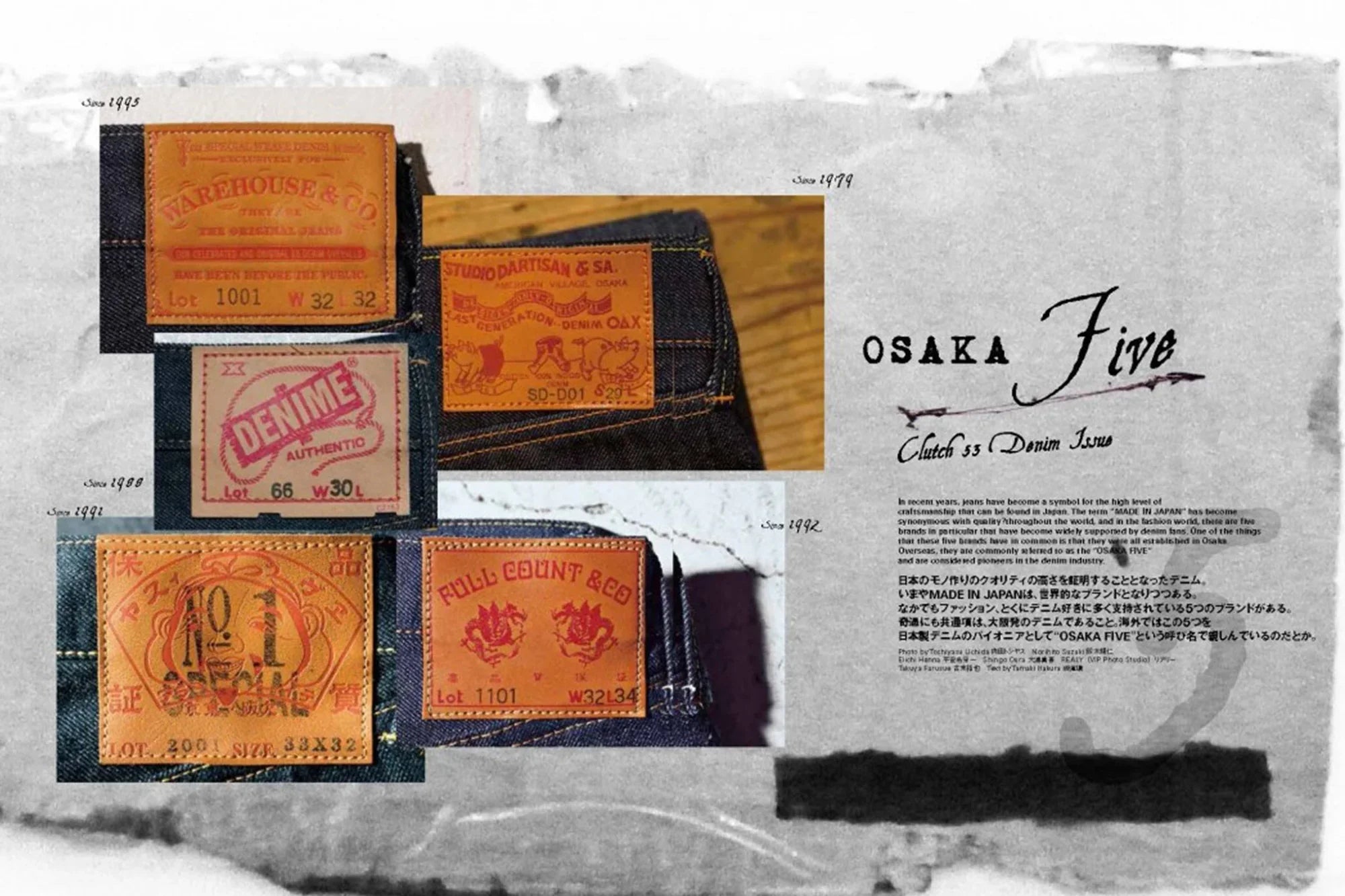
Their mission? To recreate the perfect American jeans of the 1940s and 50s. They bought old shuttle looms, relearned natural indigo dyeing techniques, and launched the "Japanese Denim" movement. Today, they're known as the Osaka Five . Here's why these five brands are legendary.
1. The 5 legendary brands you need to know
Each of these houses has its own philosophy, but all share an obsession with absolute quality.
-
Studio D'Artisan (SDA): The pioneer (1979) This is the brand that started it all. SDA was the first to dare to reproduce old-fashioned selvedge jeans.
-
The style: Known for its humorous logo (two pigs pulling a pair of jeans, a parody of Levi's) and its richly textured fabrics. It's the choice of purists who respect the brand's history.
-
-
Denime: The absolute standard (1988) Founded by Yoshiyuki Hayashi (a legend in the industry), Denime had a simple goal: to make the perfect replica of the Levi's 501 from the 60s (the famous "66" model).
-
The style: Straight, classic, timeless cuts. These are the quintessential "everyday" jeans, with a wash that becomes beautiful over time.
-
-
Evisu: The enfant terrible (1991) Probably the most well-known to the general public thanks to its hand-painted "seagull" logo on the back pockets. Evisu exploded onto the scene in 90s hip-hop culture.
-
The style: Beyond the logo, it's exceptionally high-quality denim, often dyed with a very deep indigo that takes a long time to fade (fade).
-
-
Fullcount: Comfort above all (1992) Fullcount revolutionized the market by being the first brand to use cotton from Zimbabwe .
-
The style: This extra-long fiber cotton makes the fabric incredibly soft and durable. If you're looking for the comfort of joggers with the look of vintage raw denim, Fullcount is the choice.
-
-
Warehouse: The Obsessives (1995) Their goal is not to make a pair of jeans "inspired" by vintage, but to clone them. They analyze the threads under a microscope to reproduce exactly the irregularities of the denim from the 1930s or 1940s.
-
The style: "Neo-Vintage". Canvases with grain, irregular texture and a unique patina.
-
2. Why invest in "Osaka 5" jeans?
Buying jeans from one of these brands (or their successors like Samurai or Momotaro ) is like discovering another world.
-
Selvedge denim (selvedge edge): Woven on old shuttle looms, these jeans have a selvedge edge (often red) that is visible when hemmed. The weave is tighter, denser, and much stronger than on fast-fashion jeans.
-
The Fade: This is the heart of the passion. These jeans are often sold "raw." Over time, the denim will lose its indigo in areas of friction (knees, whiskers, wallet pocket) to create a unique patina that reflects your lifestyle.
3. Size guide: Beware of "Unsanforized"!
If you are buying high-quality Japanese denim, a technical question will arise: is the fabric Sanforized or Non-Sanforized ?
-
Sanforized (The easy choice): The denim has been steam-treated to set the waistband. The jeans will hardly shrink in the wash. Take your usual size.
-
Unsanforized / Shrink-to-Fit (The purist choice): This is the authentic method from the 1940s. The fabric has not undergone any treatment.
-
Warning: During the first wash, the jeans will lose approximately 5% to 10% of their size (i.e., 1 to 2 sizes).
-
Tip: If you buy a "Raw/Unsanforized" model, always go up one or two sizes and take a hot bath before hemming.
-
